 An official website of the United States Government
Official websites use .gov
A .gov website belongs to an official government organization in the United States.

A .gov website belongs to an official government organization in the United States.

A lock or https:// means you’ve safely connected to the .gov website. Share sensitive information only on official, secure websites
 |
The RAMP Triage Model (Rapid Assessment of Mentation and Pulse) is a rapid assessment tool used to prioritize patient care during mass-casualty incidents by categorizing patients according to the severity of their injuries and need for intervention. RAMP evaluates mentation and the presence of a palpable pulse, asking patients to follow basic commands rather than requiring calculation of a Glasgow Coma Scale (GCS) score. This streamlined approach allows responders to quickly assess patient viability and determine triage priority in time-sensitive situations.
Select a view
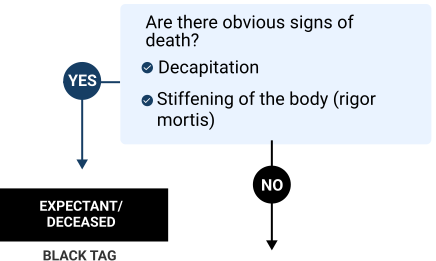
Decapitation
Stiffening of the body (rigor mortis)
EXPECTANT/DECEASED
Black Tag
Control Massive Hemorrhage
Open Airways
Chest Decompression
DELAYED
Green Tag
URGENT
Red Tag
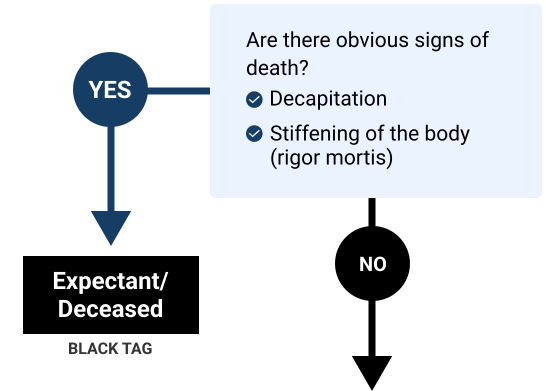
Control Massive Hemorrhage
Open Airways
Chest Decompression
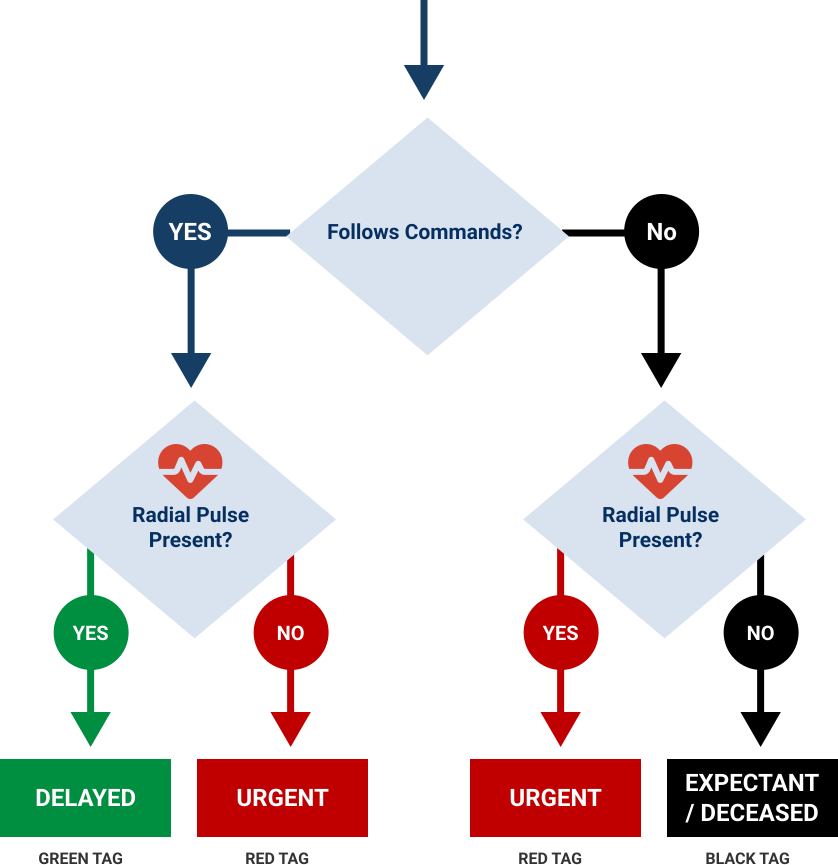
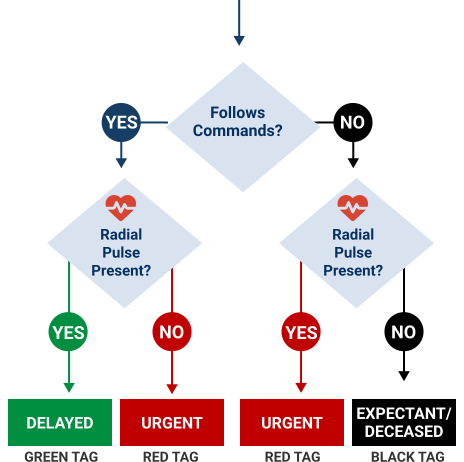
The graphic depicts a flowchart for the RAMP (Rapid Assessment of Mentation and Pulse) triage system. Medical personnel follow the RAMP system to evaluate and treat each patient not showing obvious signs of death. Triage category and tag color are based on two clinical parameters:
Mental status as assessed by the patient’s ability to follow commands
Presence or absence of radial pulse
The RAMP system sorts patients into one of three triage categories, each of which has a distinct name and triage tag color:
Urgent, Red Tag: Patient either lacks a radial pulse or does not follow commands.
Delayed, Green Tag: Patient follows commands and has a radial pulse.
Expectant/Deceased, Black Tag: Patient does not follow commands and does not have a radial pulse.