 An official website of the United States Government
Official websites use .gov
A .gov website belongs to an official government organization in the United States.

A .gov website belongs to an official government organization in the United States.

A lock or https:// means you’ve safely connected to the .gov website. Share sensitive information only on official, secure websites
 |
On January 6, 2005, a Norfolk Southern freight train collided with a parked train in Graniteville, South Carolina, releasing approximately 60 tons of chlorine gas into the air. The accident resulted in nine fatalities, over 550 injuries, and the evacuation of 5,400 residents. This case study examines the medical management and safety considerations associated with the incident.
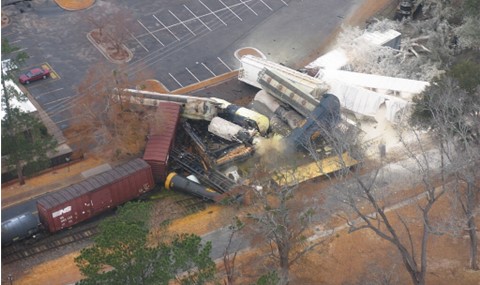
At approximately 2:39 a.m., Norfolk Southern Train 192 was diverted by an improperly aligned switch and collided with Train P22 near the Avondale Mills plant in Graniteville, South Carolina. The collision ruptured a tank car carrying liquified chlorine, causing the released chlorine to vaporize and form a dense, heavier-than-air, toxic cloud that spread rapidly through the surrounding area. The toxic gas infiltrated homes, workplaces, and the Avondale textile mill, exposing thousands of individuals to its dangerous effects. (Of particular note, first responders driving to the scene of the derailment noted that the engines of their vehicles suddenly stopped working. This was due to the displacement of oxygen from the low-lying chlorine gas cloud which caused the internal combustion engines of the vehicles to become deprived of oxygen. Unsurprisingly, this sign went unrecognized, but in retrospect was a clue to the presence of an oxygen-deficient and toxic atmosphere.) Savannah River National Laboratory performed plume modeling to predict gas dispersion. First responders lacked formal training in responding to chlorine releases, and area hospitals were unprepared for mass chemical exposure..
Chlorine is a yellow-green, noncombustible gas with a pungent odor. It is heavier than air and tends to settle in low-lying areas, making it particularly dangerous in enclosed or poorly ventilated environments. Chlorine gas reacts with moisture in the respiratory tract to form hydrochloric acid (HCl) and hypochlorous acid (HClO), both of which are highly corrosive. These reactions cause oxidative damage to tissues, leading to inflammation, edema, and often fatal respiratory failure. According to the CDC, children are more susceptible to the effects of chlorine inhalation than adults because their smaller airways can become obstructed more easily due to swelling or irritation and because their higher minute ventilation per kilogram means they take in more chlorine relative to their body size. Additionally, children may be less able to evacuate an affected area than adults.
Chlorine gas exposure can result in the following symptoms:
According to CDC Medical Management Guidelines, recommended treatment includes:
Nine deaths occurred due to chlorine inhalation, including one delayed fatality 3.5 months later. Over 550 individuals sought medical care for respiratory symptoms. Seventy-five people were hospitalized, with many experiencing pulmonary distress, skin and eye irritation, and neurological symptoms. A follow-up study found chronic symptoms in 76 individuals, with 47 still under medical care five months later. PTSD was prevalent among those with severe or prolonged symptoms. Because of the imminent threat of death posed by the toxic cloud, 5,400 people within a 1-mile radius of the derailment were evacuated.
Victims received symptomatic treatment including oxygen therapy and bronchodilators, supportive care including IV fluids and monitoring, decontamination procedures including skin and eye irrigation, hospitalization for severe respiratory distress, and mental health support for PTSD and anxiety-related symptoms.
Chlorine gas can cause secondary contamination through contact with soaked clothing or skin. Responders should remove victims from the exposure zone, remove contaminated clothing, irrigate skin and eyes thoroughly, and use chlorine-specific gas detectors to monitor air quality.
Responders must wear Level A PPE with self-contained breathing apparatus (SCBA) and chemical-resistant gloves and boots for releases involving high concentrations of chlorine gas. Lower levels of PPE may be appropriate but only based on atmospheric monitoring.
Hospitals must isolate exposed individuals, conduct decontamination before ED entry, use dedicated decontamination areas, and equip staff with butyl rubber gloves, gowns, eye protection, and respiratory gear.
In the hospital setting, the primary concern for provider safety is respiratory protection in the form of an air-purifying respirator with an acid-gas filter. Healthcare providers should minimize time in proximity to patients who have been exposed to liquids (not gas) and should wear appropriate PPE when treating patients exposed to chlorine gas, including butyl rubber gloves and gowns, eye protection, and respiratory protection. Staff should be trained to recognize symptoms of chlorine gas exposure and in the use of decontamination procedures and PPE to prevent secondary exposure.
The incident highlighted the need for rapid and accurate hazardous material identification and hazard communication. Responders quickly identified that chlorine gas was accumulating in low-lying areas and ordered evacuations accordingly. This highlights the need for evacuation and shelter-in-place decisions to be based on chemical behavior. Responder and hospital training in handling incidents involving chlorine is critical, especially in rural areas and along chlorine transportation routes. The Chlorine Institute provides such training free-of-charge. Although the Savannah River National Laboratory performed plume modeling, first responders should know how to access the free, 24/7 plume modeling and decision support assistance now available through the federal Interagency Modeling and Atmospheric Assessment Center (IMAAC). Mental health support should be integrated into disaster response.